February 15, 2009

1st Lit. Circle Mtg. - Brother, I'm Dying

Quote #1
Quote by Edwidge
page 21

"I was eight years old and Bob and I were living in Haiti with his older brother, my uncle Joseph, and his wife."
Significance: Now I know that Edwidge's family lived in Haiti before they moved to America. I also know that Haiti is in the Caribbean right next to the Dominican Republic, Jamaica, and Cuba. So not only is Edwidge's family from Haiti, they're from the Caribbean. People in the Caribbean mainly have dark skin.
Personal Connection:
We had to stay at my mom's aunt's house when we went to the family reunion in Virginia. I was nine when we went, so I was almost the same age as Edwidge when she lived in Haiti. I have always wanted to visit the Caribbean.
Question:
Do you think Edwidge had been born in Haiti, or that she and her family went to live with her uncle for awhile?

Quote #2
Quote by Edwidge
page 31
"Each time his father left for a campaign, my uncle worried that, like the thousands of Haitian guerrilla fighters who were killed by the Americans and whose corpses were dumped in roads and public parks to discourage others, his father might never come back."

Significance: Edwidge's grandfather was part of the guerrilla resistance. Last year, I read a literature circle book that talked about guerrillas, so I already know who and what they are. In Pan's Labyrinth there were guerrillas, so I got to see how they clothed themselves and what they did to get the medication they needed for their numerous wounds.
Personal Connection:
My dad is a firefighter so I know what it is like to worry if your father will come home. Firefighters have died just doing fire training. So imagine how dangerous it must be for the firefighters who are fighting a real fire.
Question:
Why would Americans think dumping bodies in roads and public parks would discourage people? If I were in Haiti when this happened, that would have only made me madder at America.

February 12, 2009

Field Trip Reflection


Children of Immigrants-

1) The image that struck me was by Jason Magabo Perez. I couldn't tell where he was, but it looked as if he was in a coffee shop with other people. The reason why the picture struck me was because a street full of cars was reflected off the window of the coffee shop, so that let me know that he was inside and that the picture was taken outside. Another thing I liked about the picture was that he was on his laptop and he was dressed in a suit. A lot of people nowadays do work and school assignments in coffee shops.

2) I chose this quote because I can relate to having been judged by my skin, because a lot of people have expected me to be dumb and lower middle-class. I also have a very loving family that supports and cares about me. My mom said that when she and my father were dating, they would always get dirty looks because my mom is Latina and my dad is Black. Usually when people think of a couple, they think the couple should be the same race or same color. I know I have done that before, but I try not to because it is unfair to the person I am judging.
"The greatest thing I hope for in my life is to become a successful person and to have a family and friends to support me, not to be looked at by just the color of my skin but who I am inside."
-Samira Durakovic, Yugaslavia

February 11, 2009

Field Trip Reflection

From Haven to Home-

The purpose of the exhibit was to learn about Jewish history, the hardships they went through, and how they helped shape American history. The most surprising fact I learned today about Jewish history is that Jews invented the Barbie Doll. I had no clue who made the dolls; I only had known what they were. A few important Jews are Dr. Seuss, Ernstine Louise Rose, Jerry Seinfield, Bess Myerson, and Albert Einstein. Dr
. Seuss is the world-famous author of the books The Cat in the Hat, How the Grinch Stole Christmas, and Horton Hears a Who. Dr. Seuss is also known as Theodor Geisel. Ernstine Louise Rose was a woman who rebelled against traditional arranged marriage. In order to be considered married, a couple required a marriage contract. Jerry Seinfield is a famous actor; Bess Myerson was nominated Miss USA in 1945. Albert Einstein was the man who discovered Energy=Mass*Speed of Light2 (E=MC2) Albert Einstein was famous for his amazing understanding of universal forces. Jews were also very active in the Civil Rights Movement (they boycotted with MLK Jr.), because they wanted a better life for everyone, not just themselves.
Instead of having a bible, Jews have a torah.In the 1800s in presidential elections, candidates had to swear on a Christian bible which outlawed Jews. But in 1825 the "Jew Bill" was passed which meant that instead of declaring themselves in belief, they had to take an oath to serve the US. Jews have a calendar called the Omer calendar that marks the seven weeks between Passover and Shavu'ot.


Jews went through a lot of hardships that people are unaware of. Since Jews are on kosher diets, they have to buy kosher meat. But the Jews were paying twice as much for kosher as the Americans were paying for their meat. So 20,000 Jewish women broke into kosher butchers' shops and burned them to the ground. Jew
s also went through religious persecution, grinding poverty, and violent attacks which were called pogroms. When the Ku Klux Klan showed up, they only made life harder for the Jews because the Ku Klux Klan were a "secret" organization that hated Jews, Catholics, and African-Americans. And in the 1930s, Adolf Hitler popped up and turned the Germans against the Jews by saying they were the reason for the economic woes and their loss in World War II. When that began, concentration camps started to be built so that Germans could freely torture and kill Jews. That's just part of the stuff Jews went through. The Jewish community has helped build America, and in the process has taken life-changing risks.

February 6, 2009

Immigration Reflection

An immigrant is a person that has left their country and is living as a resident in the country they migrated to. Most of the immigrants in the US come from Latin American countries such as Mexico. People migrate from all over the world, but when they don't register as legal immigrants they fall under the category of "illegal aliens". "Illegal aliens" is a very biased and disrespectful term, because humans are not aliens. Illegal immigrants are not little green extraterrestrial creatures with bug eyes.

All immigrants come to America for their own reasons, but I'll tell you a few of the reasons I think they might want to come live in America. If the level of crime in their country is high is a good guess, because who wants to be afraid to go outside because of the level of crime? Maybe even the the environment; what if somebody did not like living in a humid rain forest? There are plenty of dry places they could go to, such as San Diego. San Diego has great weather and does not get so humid to the point where a person is uncomfortable.

The US is a great place to take advantage of opportunities. We have a wide variety of culture, food, ethnicity, music, and jobs that other countries may not be able to offer because of their government and economy. If you drive down any street in San Diego, you will see at least one restaurant that is derived from another country. Some of the job opportunities that you can't get in another country is being a humanitarian or an author that is known world-wide. If an immigrant were to become a humanitarian, they could help their family if they were living in bad conditions and also children in Africa. They could change the world. Being an author could inspire and change the lives of children and adults that are less fortunate than others. All of the job opportunities in the US are life changing, and you can get that in other countries but not nearly as much.

Because so many people have migrated to the US, we have great diversities of culture and religion. Immigrants from continents all over the world bring their accents, cultures, religions, appearances, languages, and much more. Because of all of the "new people" entering the US, we have had to adjust by making amendments that protected them. For example, the 13th and 14th Amendment both protect people from racism and degradation.

My life has not changed that much in 13 years due to immigration, but the 20th century has shaped my life. If not for the Civil Rights Movement, the Brown v. Board of Education case, and other occasions where minorities have tried to bend the rules for the better, I might not be on the computer typing up a blog post. I might not have been going to a good school or having white friends. Immigration has shaped my life, not changed it.

January 16, 2009

When Broken Glass Floats by Chanrithy Him


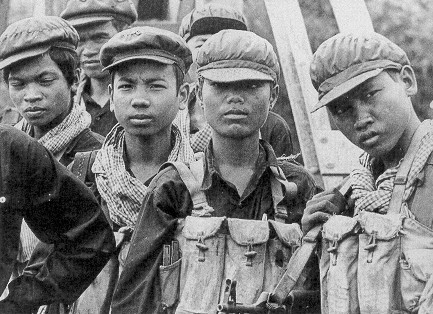
I greatly enjoyed reading When Broken Glass Floats because it was both heartwarming and heartbreaking at the same time. This was the second book I've read that has made me cry because it was so sad. When Broken Glass Floats is about Chanrithy's childhood and how half of her family was killed because of the Khmer Rouge holocaust. The Khmer Rouge took over Cambodia and vacated all of the cities and forced everyone to live in huts. Anyone who opposed them was murdered and/or tortured. Chanrithy's family cooperated with the Khmer Rouge in hope of keeping their lives. Instead of shopping for groceries everybody was given food rations, though it was not enough to feed Chanrithy's family of nine. Over time the amount of food that was distributed dwindled, and many died of starvation. Throughout the book I kept on thinking that it couldn't get any worse for Chanrithy, but tragedies continued to occur.

I would recommend this book to high schoolers because it is so sad and brutal how all of these innocent people died trying to take care of their families and themselves. I know that if I had survived that like Chanrithy, I would never trust anyone again. Yet Chanrithy Him went to America and got her B.S. in biochemistry. Now she is working for the Khmer Adolescent Project and studies post-traumatic stress disorder among Cambodians that survived the Khmer Rouge holocaust.

This book was tragic and to think that Chanrithy was only nine when it began is just amazing, but sad because she spent all of her teenage years as a slave. She was forced to do work when she was ill and had a horribly infected foot. The Khmer Rouge had no hearts whatsoever because if they did they would not have been so cruel and brutal towards innocent civilians. I loved the book, but it just got too sad for me at times. That was part of the reason why I had recommended it to high schoolers; because I am a very mature reader but I emotionally almost couldn't handle this book. The Khmer Rouge were killing babies and pregnant women! The sorrows of this book were quite shocking.

This book gave me a lifelong lesson to not take anything for granted; especially your family and friends because they could be taken away at any second. Not only that, but I also learned a little bit of history. And since the book was about a first-hand experience, I got more facts than I would have if somebody had interviewed a survivor or researched the Khmer Rouge holocaust.